Reconnecting to Yourself and the People You Love Through Mindfulness
So often, when couples or individuals come into my office, they believe the problem is the behavior:
“I shouldn’t snooze.”
“I shouldn’t snap.”
“My partner shouldn’t be so distant.”
But more often than not, the deeper issue isn’t the behavior itself but the state we’re in when we interpret it.
Mindfulness helps us reconnect not just to calm, but to clarity. And that clarity changes the story we tell about ourselves and the people we love.
A Very Simple Explanation of Polyvagal Theory
While this isn’t a deep dive into polyvagal theory, it can be helpful to understand one key idea from the work of Stephen Porges, who developed the theory.
In simple terms:
Your nervous system has different “modes” it moves through depending on whether it senses safety or threat.
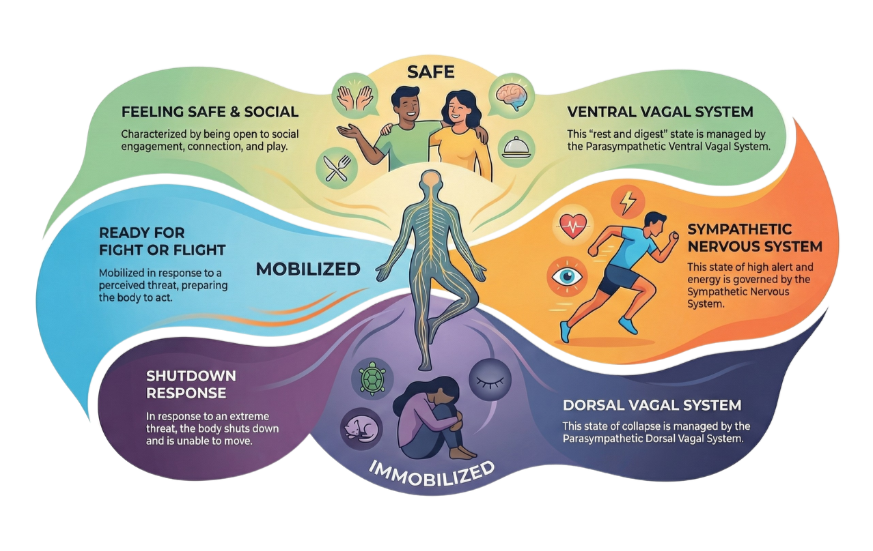
Think of it like a traffic light:
Red (Sympathetic Activation) – Fight or flight. We feel irritated, anxious, reactive, critical.
Blue (Dorsal Shutdown) – Collapse or disconnection. We feel hopeless, numb, withdrawn.
Green (Ventral/Safe & Connected) – Calm, grounded, open, relational.
Here’s the important part:
Your nervous system state influences the story you tell.
The same behavior can mean something wildly different depending on whether you’re in red, blue, or green.
Let’s experience this directly.
A Mindfulness Experiment
This is not about fixing anything. Just noticing.
Step 1: Pick a Mildly Irritating Behavior
Think of something you do that annoys you just a little.
Maybe:
Snoozing your alarm
Eating a second chocolate chip cookie
Snapping at your preschooler
Pause for a moment.
Now ask yourself:
What story do I tell about myself when I do this?
Is it:
“I have no discipline.”
“I’ll never change.”
“What’s wrong with me?”
Just notice.
Step 2: Activate Yourself (Just a Little)
Now think about something somewhat frustrating that happened recently.
Maybe:
You got stuck in traffic.
A cashier was rude.
An email felt dismissive.
Let yourself feel a bit of that irritation.
Now go back to that mildly irritating behavior you do.
What story are you telling now?
Often in “red,” the tone becomes more critical:
“I’m so lazy.”
“I’m such a bad parent.”
“No wonder things don’t work out.”
Step 3: Regulate with Slow Breathing
Now let’s shift to another state.
Try this breathing pattern:
Inhale for 4 seconds
Hold for 4 seconds
Exhale for 4 seconds
Pause for 4 seconds
Repeat a few times.
Let your body settle.
Now think about a time you felt sad recently.
Maybe:
Your partner missed a bid for connection and you felt alone.
A friend didn’t show up for you the way you needed.
You felt unseen or unappreciated.
Dip a toe into that feeling and let it wash over you a little.
Now return to that mildly irritating behavior.
What’s the story now?
When we’re in “blue,” the tone often becomes:
“I’ll never get better.”
“This is just who I am.”
“Why even try?”
The tone is generally saturated with more hopelessness compared to anger when in the red zone.
Step 4: Energize
Now let’s move your body.
Do some jumping jacks. Get your breathing up.
Or try goalpost breathing:
Bend your arms like goalposts, elbows in front of you, hands in soft fists.
Inhale as you open your elbows wide.
Exhale as you bring them back together.
Do this quickly and repeatedly until you feel energized.
Now think of something that made you happy recently.
Really picture it:
What felt good?
Where do you feel it in your body?
What emotion is present?
Let that expand.
Now return to that mildly irritating behavior.
What’s the story now?
When we’re in “green,” the tone shifts:
“Okay, I snoozed. I was tired.”
“I snapped. I can repair.”
“I am hungry and mindlessly eating.”
In green, there is clarity and compassion.
We can hold both responsibility and kindness.
Why This Matters in Relationships
When we’re in red, our partner’s behavior looks intentional and personal.
“They don’t care.”
“They’re selfish.”
“They always do this.”
When we’re in blue, it can become:
“Nothing will ever change.”
“I guess I just have to live with this.”
“I’m alone in this relationship.”
But in green?
We can wonder instead of accuse.
We can empathize instead of defend.
We can ask instead of assume.
Mindfulness is about noticing and being present with what is happening for us:
What am I feeling in my body?
What emotion is present?
What message is this emotion carrying?
What behavior am I about to engage in because of this activation?
When we pause long enough to notice, we can regulate ourselves and choose behaviors that connect rather than disconnect.
The Invitation
The next time you catch yourself telling a harsh story about:
Yourself
Your partner
Your child
Your friend
Pause and ask:
What state am I in right now?
Because the story often changes when your nervous system changes.
And when you build the muscle of mindfulness, you create space for compassion, growth, and repair.
Mindfulness is a muscle that gets better with practice. You can exercise this muscle through mindfulness meditation. If you feel this would be helpful to you and are feeling stuck, therapy can help.
